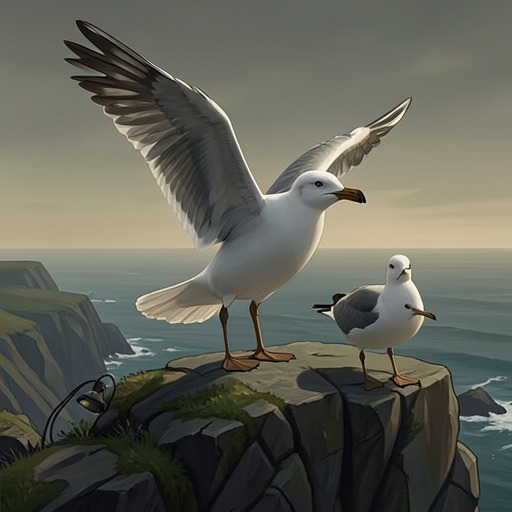
The master-apprentice relationship between Jonathan Livingston Seagull and Chiang
Jonathan Livingston SeagullThe teacher–student relationship between Jonathan Livingston Seagull and Chiang transforms flight from Jonathan’s lifelong pursuit into a way of understanding perfection, freedom, and love. Chiang does not merely give a gifted flyer new techniques: he teaches Jonathan to question the limits he has mistaken for reality, and then leaves him with a task that turns private mastery into instruction for others.
Meeting and Recognition
Jonathan approaches Chiang one evening while the gulls who do not fly at night stand together on the sand, thinking. The old gull is said to be nearing the time when he will move beyond this world, yet age has strengthened rather than diminished him: he can outfly any gull in the Flock and possesses skills that the others are only gradually beginning to learn. The setting establishes Chiang as both an accomplished practitioner and a teacher whose knowledge exceeds ordinary measures of age and ability.
Jonathan asks whether this world is heaven. Chiang’s answer redirects the question: heaven is not a place or a time, but being perfect. He then connects the idea to the quality Jonathan already prizes most, speed. No numerical velocity, however astonishing, can be perfect, because any number sets a limit. Perfect speed, Chiang explains, is being there. With that distinction, he shifts Jonathan’s desire from going faster through space toward understanding what it means not to be bound by space and time.
Instruction in Thought-Speed Flight
Chiang makes the abstract lesson visible. Without warning, he vanishes and appears at the water’s edge fifty feet away, then vanishes again and stands at Jonathan’s shoulder in the same instant. He explains that he has gone wherever and whenever he can think of, and challenges the assumption that travel is the same as progress: gulls who scorn perfection for travel go nowhere slowly, while those who set travel aside for perfection can go anywhere instantly. Jonathan is dazzled and asks how Chiang does it, what it feels like, and how far it can take him.
Chiang offers to begin at once. To fly as fast as thought, Jonathan must first know that he has already arrived. The obstacle is not simply his skill in moving wings: he must stop regarding himself as a limited body with a forty-two-inch wingspan and measurable performance. Chiang teaches him to understand his true nature as perfect and unlimited, present everywhere across space and time. The lesson recasts flight as a change in understanding, not a contest in physical speed.
Jonathan works at the practice fiercely, day after day, from before sunrise until after midnight, yet at first he does not move even a feather-width from his spot. Chiang repeatedly tells him to put faith aside and understand the new kind of flying as he had learned ordinary flight. The breakthrough comes when Jonathan stands on the shore, closes his eyes, concentrates, and recognizes himself as a perfect, unlimited gull. He feels a shock of joy; Chiang answers with a word of approval in which victory is audible. When Jonathan opens his eyes, they are alone on a different shore, with trees reaching the water’s edge and twin yellow suns overhead. The strange new landscape gives concrete form to the change his teacher has helped him make.
A Continuing Education
Chiang’s teaching continues beyond the first breakthrough. He proposes that Jonathan work with time until he can fly into the past and future, and then undertake the most difficult and powerful learning of all: to fly upward and understand kindness and love. This places ethical understanding at the culmination of the instruction. The relationship is not complete when Jonathan masters a spectacular ability; that ability prepares him for a deeper lesson about how to live and relate to others.
Jonathan learns rapidly under Chiang’s guidance, but the account preserves the patient, incremental character of their training. In another practice session, he and his instructor work on formation point-rolls. Jonathan must think upside down during the inverted half, reverse the curve of his wings, and keep that reversal exactly in harmony with Chiang’s. They repeat the exercise, then move on to outside loops. The lesson is simultaneously individual and shared: Jonathan must acquire control of his own movement while matching his teacher’s movement precisely.
Chiang’s influence also changes Jonathan’s understanding of what learning is for. Jonathan had loved flight more than food long before he met him, but Chiang gives that devotion a new intellectual and spiritual direction. At the end of one stage of training, understanding makes Jonathan see that he can fly higher and that it is time to go home. He takes one last look across the magnificent silver land where he has learned so much, then says he is ready. The decision to leave the place of instruction does not mean its lessons have ended; it marks their transfer into a new purpose.
Departure and Inheritance
Chiang eventually vanishes while speaking quietly to the gulls, urging them never to stop learning, practicing, or striving to understand the perfect, invisible principle of life. As his feathers grow brighter and brighter, until no gull can look upon him, he gives Jonathan a final, direct instruction: to keep working on love. When the others can see again, Chiang is gone. His departure is presented not as a rupture in the teaching but as its decisive emphasis: Jonathan’s next work concerns a lesson that cannot be reduced to speed or technique.
In the days afterward, Jonathan repeatedly thinks of Earth and wonders whether a gull there might be struggling to exceed familiar limits, or might have been made an Outcast for speaking a truth the Flock cannot accept. As he practices kindness and tries to understand love, his wish to return grows stronger. He recognizes himself as born to be an instructor, and understands giving another gull a chance to see the truth for himself as his way of demonstrating love. Chiang’s final charge thus shapes Jonathan’s choice: he will carry what he learned into a world where others may need the chance to learn it.
Jonathan’s farewell to Sullivan makes clear that leaving one world does not require the destruction of friendship. He argues that overcoming space leaves only here, overcoming time leaves only now, and that in the middle of here and now they might meet again. He then holds in thought an image of the great gull-flocks on a shore in another time, understanding himself not as bone and feather but as a perfect idea of freedom and flight, limited by nothing. That insight carries Chiang’s teaching into the next part of Jonathan’s life: thought can cross the limits that once seemed to separate places and moments.
From Student to Teacher
Jonathan’s return to Earth makes the transmission of Chiang’s teaching visible in practice. After training Fletcher Lynd Seagull, Jonathan corrects a failed maneuver with specific, attentive feedback: Fletcher has lost forty miles an hour on entry and is pulling up too hard, so he must make the movement firm but smooth. Jonathan then drops to Fletcher’s level and asks him to try the move in formation. The method echoes the learning he received from Chiang: demonstration, repeated practice, precise correction, and working in coordination with a more experienced flyer.
By the end of three months Jonathan has six students, all Outcasts, curious about the idea of flying for the joy of flight. Their ability develops faster than their understanding of its meaning; it is easier for them to practice high performance than to grasp why they are doing it. Jonathan teaches that each gull is an unlimited idea of the Great Gull and that precision flying expresses a more fundamental nature. The distinction between acquiring a maneuver and understanding its significance recalls Chiang’s insistence that Jonathan must understand flight rather than rely on faith or visible limits.
The teaching grows beyond the first group. At night, curious gulls gather around the students’ circle to listen in darkness, disappearing before daybreak so that they need not be seen. A month after the Return, Terrence Lowell Gull crosses the line and asks to learn; the request makes him an Outcast and the eighth of Jonathan’s students. The next night Kirk Maynard Gull arrives dragging his left wing and asking for help because he wants to fly more than anything. Jonathan invites him to climb away from the ground and begin. This widening circle shows the consequence of the chain begun with Chiang: instruction passes from teacher to student, and from student into a community of learners.
The final transfer occurs when Jonathan vanishes and Fletcher, after a time, drags himself into the sky to face a new group of eager students. Fletcher begins by teaching that a seagull is an unlimited idea of freedom and that the body, from wingtip to wingtip, is thought itself. The young gulls are puzzled; they expected a rule for a loop. Their response preserves the gap between practical technique and the larger idea behind it. Chiang’s teaching reaches them through Jonathan and Fletcher, but its meaning still has to be learned, not merely repeated.